
For APIs that return multiple records, optional pagination and sorting is available. It is recommended that pagination is used for API calls that may return large amounts of data. To see if pagination or sorting is supported for an API, refer to the Request section for each individual API.
In the HTTP request header, you can include page_info and specify the following pagination and sorting parameters:
| Item | Description | |
page_number |
The requested page (if not specified, then page 1 is returned by default) | |
total_records_per_page |
Total records per page (in general up to and including 200, although certain APIs may support to 500 records per page. If not specified, then 50 records are returned per page by default. For more information, refer to the API specification page.) |
|
| order_option | The field by which to sort the returned results | |
| order_by | ASC | Sort returned results by ascending order |
DESC |
Sort returned results by descending order | |
The response body contains the following pagination information:
| Item | Description |
total_records |
The total number of records. |
total_page |
For the requested total_records_per_page, this is the total number of pages required to transfer all of the records. This is equal to: Int (total_records / total_records_per_page) |
For example:
To:
sort membership packages by package_name
sort in ascending order
display 10 membership packages per page
view the second page
add the following content to the request header:
"page_info": {"order_by": "package_name","order_option": "ASC","total_records_per_page": 10,"page_number" : 2}
If there are 1359 membership packages, then a total of int(1359 / 10) = 136 pages will be required.
Example request and response:
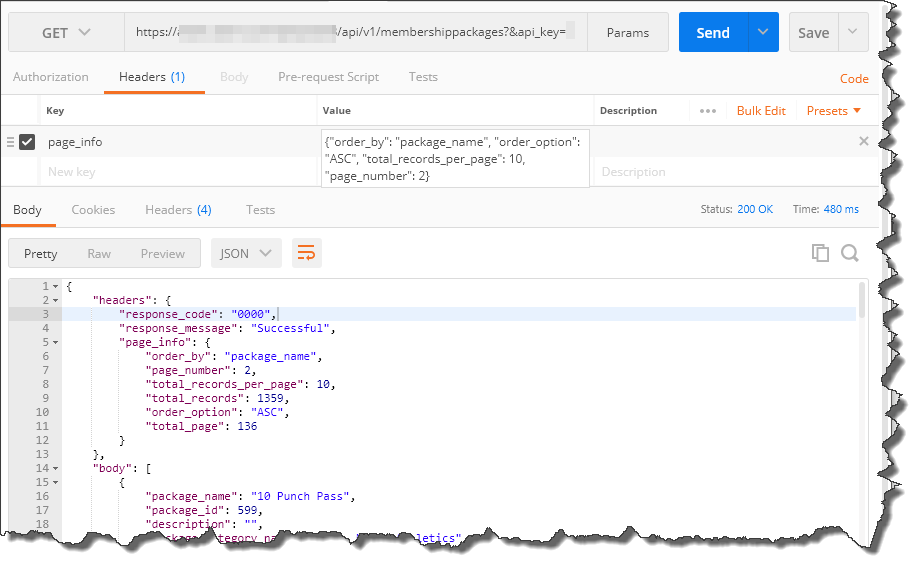
Retrieving data from ACTIVE Net